British Admiralty
The Good ShepherdThe British Admiralty is presented through two consequential functions: transmitting intelligence about U-boat concentrations and judging whether a reported sinking merits official credit. Its warning reaches Krause when his ship is already among the enemy concentration it identifies, while its demand for proof presses against the immediate need to protect the convoy. The organization’s power therefore depends not only on what it can discover, but on when its information arrives and what evidence it will accept.
Intelligence and the Wolf-Pack Warning
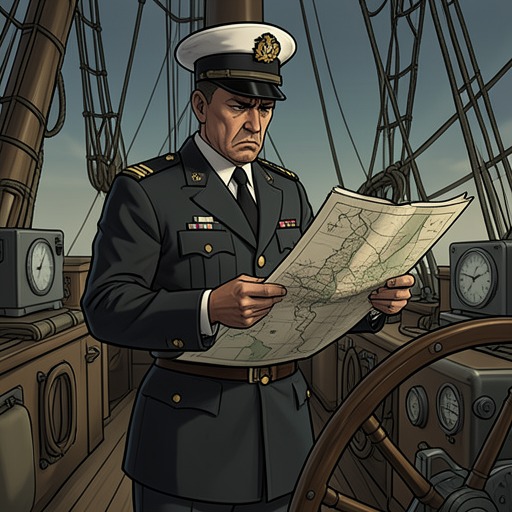
The clearest display of the British Admiralty’s intelligence work is a message reporting an enemy concentration, giving its latitude and longitude, and recommending a radical change of course southward. The message is addressed to Krause as Comescort. When he reads it, the coordinates place Keeling within a mile or two of the reported concentration: the warning is strikingly precise, but arrives when the danger is already present.
The message is two hours old, which the narrative treats as the fastest transmission that could be expected. The British Admiralty staff has used charts and a plotting board to pinpoint the concentration, yet the information’s value is limited by the time required to move it through the system and by the convoy’s physical momentum. Turning the convoy would take seconds to order, but minutes to relay and confirm across its ships; the unscheduled maneuver would also risk renewed disorder and straggling. Accurate intelligence does not automatically produce a safe or practicable response.
The Limits and Secrecy of a Warning
Krause concludes that the convoy has to fight through the wolf-pack and continue across the Atlantic. He does not pass the warning to his subordinates or the Commodore, reasoning that it could not alter their actions. The narrative adds another consideration: the fewer people who know how accurately the British Admiralty can locate U-boat concentrations, the better. The warning thus has a double edge. It informs the escort commander, but its precision is treated as sensitive knowledge whose circulation should be limited.
That choice also distinguishes intelligence from orders that can be acted upon. The British Admiralty recommends a major course change, but by the time its message reaches Keeling, carrying out that recommendation would disrupt a convoy already moving forward. The episode does not portray the intelligence as useless: it confirms the scale and location of the threat. It shows instead how transmission delay and the convoy’s organization can separate knowing where danger lies from being able to avoid it.
Evidence, Victory, and Official Credit
The British Admiralty’s institutional role extends beyond warning. After a U-boat has been attacked, the Polish captain asks to search for proof of its sinking. Krause understands the request as a response to his orders and recognizes that proof matters to staffs in Washington and London as they prepare their assessments of the situation. A claimed success must be made legible beyond the ships involved.
The account contrasts the British Admiralty’s insistence on positive proof with uncertainty about whether the Navy Department is equally strict. It notes a sailors’ joke that nothing short of the U-boat captain’s pants would satisfy the authorities. Beneath the humor lies a serious professional consequence: the Polish captain’s naval career and standing depend in part on whether his claim is accepted. Krause refuses permission for the search and orders him back to his place in the screen, because the convoy is almost unguarded. The demand for verification is important, but it cannot take precedence over immediate protection.
Institutional Significance
Across these episodes, the British Admiralty is neither an all-seeing command nor a distant bureaucracy without operational effect. Its staff can identify a concentration with remarkable precision, and its standards shape how combat success is recorded; nevertheless, the warning arrives too late for a safe change of course, and the search for proof competes with the need to maintain the escort screen. The organization’s influence is real but mediated by delay, communication, evidence, and the finite ships available at the scene.